The author
MwalimuDr. Cephas Kwambiliwa
- Educator
- Researcher
- Author
- Trainer
- Practitioner of transformational leadership
The person behind ATTITUDE has been working on a single question, from the classroom to the institution: how an inner disposition becomes a shared culture.
Mwalimu — the teacher. The word belongs to his public and educational identity; it is not a decorative title.
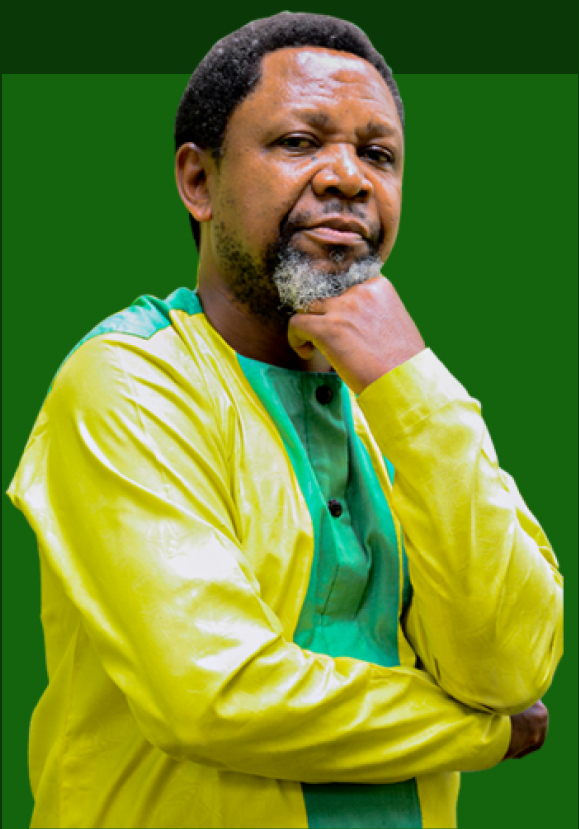
Mwalimu Dr. Cephas Kwambiliwa
02 — The person behind ATTITUDE
A path running from the classroom to the culture of institutions.
His work does not reduce to a list of positions. It reads better as a progression: to educate, then to transform, then to lead, then to rebuild a culture, then to build people and institutions.
Education
Education is both his starting point and his method. Teaching is not the delivery of content but the forming of a way of thinking, questioning and standing before reality.
Transformation
His research addresses transformational education: an education that does not merely inform, but shifts the inner disposition of the person.
Leadership
As a practitioner of transformational leadership, he works with leaders, teams and institutions on what precedes the decision: the attitude from which it is made.
Culture
His cultural transformation work aims at the move from a scarcity culture to a Culture of Abundance — and at entrepreneurship built on existing assets rather than on what is missing.
Building people and institutions
The purpose is not inspiration but the formation of builder-transformers: people able to hold a culture over time, in their family as much as in their institution.
03 — The central conviction
Mon attitude crée ma réalité.
Mon attitude transforme mes réalités.
Mon attitude attire ma multitude.
These three sentences are not cover slogans. They condense the conviction running through his entire body of work: the inner shift precedes visible change, and it never stops at the person.
How far the shift travels
- Self
- Family
- Institution
- Community
- Nation
The same grammar structures the book, the movement and the coaching: what is transformed within a person eventually transforms what surrounds them.
04 — Fields of transformation
A map of ideas, not a catalogue of services.
ATTITUDE did not emerge in isolation. The book sits inside a wider set of intellectual territories the author has worked from education outwards.
- Transformational education
- An education that forms disposition before it accumulates content.
- Transformational leadership
- Leading from a held attitude rather than from positional authority.
- Cultural transformation
- Working on the culture of a household, a team, an institution.
- Culture of Abundance
- Leaving scarcity culture behind as a way of reading the world.
- Entrepreneurship from existing assets
- Starting from what is already present instead of waiting for what is missing.
- Critical thinking
- Examining one's own interpretations before blaming circumstance.
- Creative and entrepreneurial thinking
- Designing responses where habit sees only an obstacle.
- Values, responsibility and empowerment
- The move from victimhood to assumed responsibility.
These territories overlap. Together they form the intellectual context in which ATTITUDE makes sense.
05 — TEAC
TEAC
Transformational Education for Abundance Culture
The transformational education model initiated by the author.
TEAC is the transformational education model initiated by Mwalimu Dr. Cephas Kwambiliwa. It places the formation of the person — how they think, create and choose — at the center of the educational act.
It is the wider frame in which his thinking sits. ATTITUDE is its published expression: the book carries the central argument without exhausting the model.
At the heart of the model
- Critical thinking
- Learning to question one's own interpretations.
- Creative and entrepreneurial thinking
- Learning to produce a response from available assets.
- Values
- Learning to hold a conduct when circumstance does not require it.
What the model sets out to form
Builder-transformers: people who do not wait for transformation but carry it into their family, their institution and their nation.
ATTITUDE remains the subject of this site. TEAC appears here because it illuminates the author's thinking, not as a brand that contains it.
06 — The transformation ecosystem
One body of work, several places of expression.
A few initiatives surround the author's thinking, each carrying one dimension of the work. They are described for what they express, with no assumed legal or corporate relationship.
- AROMAEducational and generational expression
- The educational and generational side of the work: passing transformation on to those who follow.
- BFS — Back to the Foundation SynergySpiritual foundation and transformation
- The spiritual foundation of the transformation work as the author carries it.
- ALFA PublishingPublishing context
- The publishing house behind ATTITUDE, giving the argument its printed form.
In words: Mwalimu's thinking is expressed through the TEAC model; AROMA carries its educational and generational dimension, BFS its foundational dimension, and ATTITUDE is its publication, issued by ALFA Publishing.
This work extends beyond a single publication: it also takes the form of a transformation movement.
The Movement07 — Author of ATTITUDE
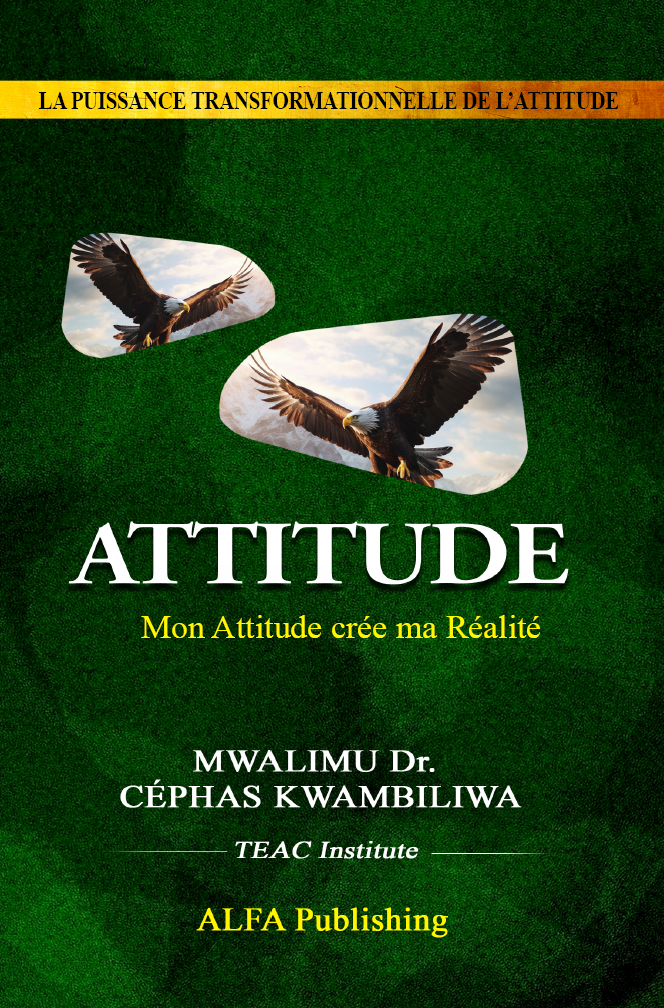
The book is the published form of this thinking.
ATTITUDE — La Puissance Transformationnelle de l'Attitude gathers into one volume the argument the author works on in education, leadership and culture.
The book does not summarise everything he does. It fixes the entry point: attitude as the disposition that precedes how we read reality, and as the starting point of any lasting transformation.
08 — From thought to practice
Three ways into this work.
The author's work does not stop at writing. These three pathways are how his thinking becomes practice, with people and with institutions.
Coaching
Demanding personal coaching around transformational attitude, leadership, responsibility and culture — for leaders, executives and teams.
CoachingWorkshops
Collective working sessions: from book to transformation, the 12 laws, from victimhood to responsibility, from scarcity to abundance, ATTITUDE for educators and for youth.
WorkshopsConferences
Public intervention: carrying the argument before an institution, a university, an educational forum or a leadership event.
Conferences
For an institution seeking to embed this work in its own culture, a distinct framework exists.
Organizations09 — Speaking
Carrying the argument before an audience.
Mwalimu Dr. Cephas Kwambiliwa speaks on attitude as a force of transformation, in education as much as in leadership.
- ATTITUDE: the invisible force behind transformation
- My attitude creates my reality
- From scarcity culture to a Culture of Abundance
- Transformational leadership begins with attitude
- Education for transformation: raising nation builders
The full catalogue of speaking themes is presented on the Conferences page.
Languages
French and English.
Settings
- Institutions
- Conferences
- Universities
- Leadership events
- Educational forums
10 — Work with Mwalimu
Four ways to engage this work.
Invite Mwalimu
For a conference, an institutional intervention, a university or an educational forum.
Invite MwalimuTransform
Request personal or team coaching.
CoachingLearn
Organize a workshop for a team, a school or an institution.
WorkshopsRead
Enter the work through the book itself.
Discover ATTITUDE